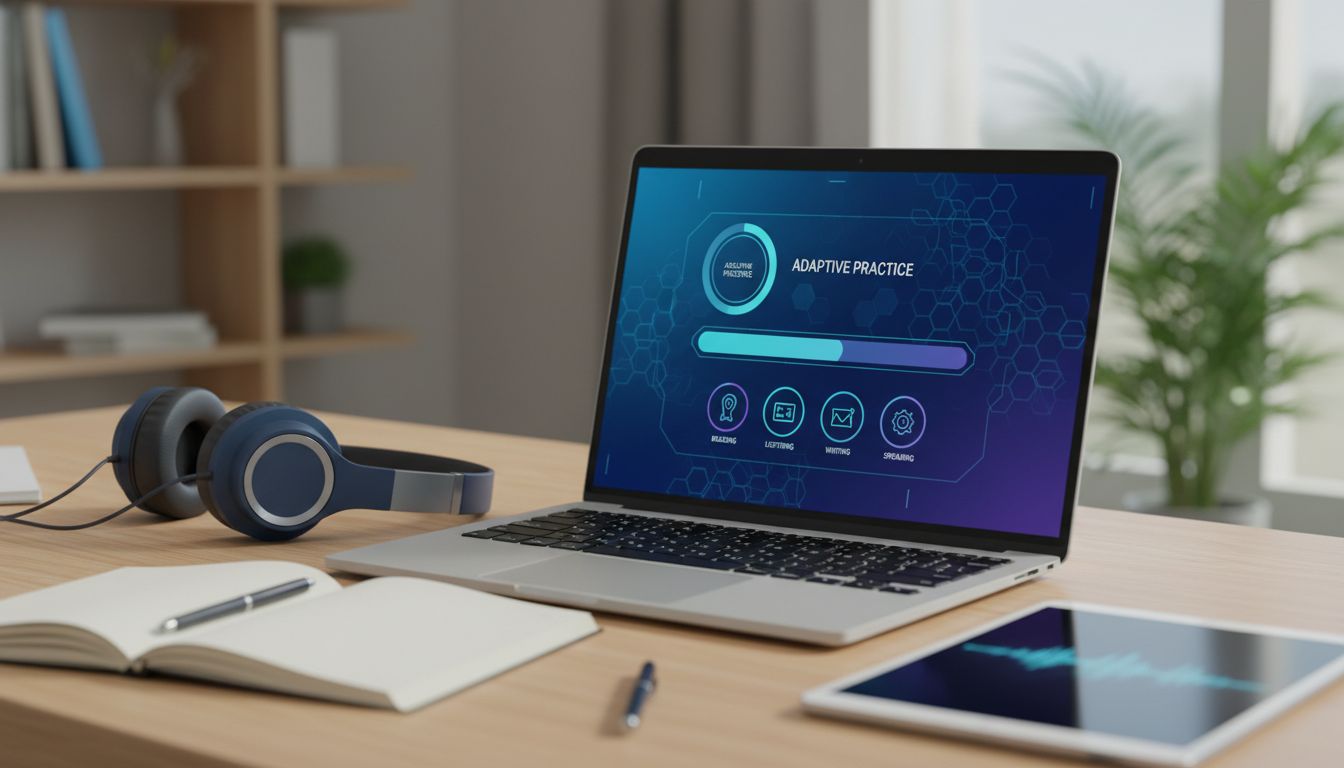
Prepare smarter for computer-delivered English tests with adaptive practice
Computer-delivered English tests are now the standard for many admissions, scholarship, and job pathways. Whether you plan to take IELTS on computer, PTE Academic, or the Duolingo English Test, you can prepare more efficiently by letting data guide what you study and how you practice.
This guide explains how adaptive practice for computer-delivered English tests boosts your score with less wasted time. You will learn how to diagnose your current level, build a targeted plan, master the digital test interface, and keep improving with feedback loops designed for learners in Bangladesh.
Understand adaptive testing and why it matters
Adaptive testing adjusts question difficulty in real time based on your performance. Tests like PTE Academic and the Duolingo English Test use this approach, while others, such as IELTS on computer, present fixed-form sections but still benefit from adaptive preparation. The goal is the same: to estimate your proficiency precisely and efficiently.
When you practice adaptively, you meet questions that are neither too easy nor impossibly hard. This keeps you in the “learning zone,” where each attempt stretches your ability just enough to build skill and confidence. Over time, your practice history creates a map of strengths and gaps that a smart system can use to recommend what to study next.
Even if your target exam is not adaptive, adaptive practice still matters. It accelerates improvement by prioritizing your personal weak spots,timing, grammar patterns, listening detail, or speaking coherence,so every session pushes you closer to your score goal.
Diagnose your level with a smart baseline
Start with a short but well-designed diagnostic across reading, listening, writing, and speaking. Aim for 30,45 minutes that sample core skills and mimic computer-based conditions. Record your typing speed, note any timing stress, and capture audio for speaking so you can assess pronunciation, fluency, and clarity.
For learners in Bangladesh, test on the device you will likely use on exam day. If you rely on a desktop at a local lab or cybercafé, try the diagnostic there too. Note internet stability, background noise, and power backup options. Practical details affect performance, so include them in your baseline notes.
Use your results to label skills as “strong,” “stable,” or “needs work.” A clear baseline prevents guesswork and helps you set realistic targets, such as moving reading from B1 to B2 in six weeks or lifting writing coherence by one band with focused paragraphing drills.
Build a personalized study plan with data
Turn your diagnostic into a weekly plan that allocates more time to high-impact gaps. If listening detail is weak, schedule daily 15-minute micro-sessions focused on dictation, shadowing, and question-type drills. Keep your strong areas warm with short maintenance sets so they do not slip.
Transform data into habits. Track how many items you attempt, your average accuracy by question type, and how your timing changes week by week. If you consistently miss inference questions in reading, add targeted passages at the right difficulty and set a small goal like “80% accuracy within eight minutes.”
In Bangladesh’s busy study context, keep plans practical: commit to short, focused sessions you can sustain around classes, coaching, or work. When bandwidth is limited, download audio and reading sets in advance, and use lightweight note apps to capture mistakes and model answers.
Master test interfaces and timing strategies
Computer-delivered exams reward interface fluency. Practice with on-screen timers, navigation panels, and flagging tools so you move confidently between items. Learn keyboard shortcuts for quick editing in writing tasks and get comfortable with digital note-taking or minimal scratch work for planning.
Build typing stamina to 35,45 wpm with high accuracy so idea generation, not mechanics, becomes your focus. For speaking tasks, rehearse with a set and a countdown timer. Train yourself to breathe, outline a structure in seconds, and start strong within the recording window.
Simulate real constraints. Set fixed time budgets per question type and stick to them. If your exam center could be cool or noisy, practice with light background sound or a fan running. Small adjustments now reduce surprises and anxiety on test day.
Practice the skills that adaptive engines reward
Adaptive engines quickly detect consistency. In reading, they reward reliable comprehension of main ideas, logical connectors, and inference. Build these micro-skills with graded passages and immediate feedback, then increase difficulty once you sustain accuracy under time.
Listening sections value attention to detail and note efficiency. Practice with short clips at first, summarizing key points in one or two lines. Gradually add accents common in global English so you are ready for the variety you may meet on PTE or DET.
Writing and speaking benefit from clear structure and controlled language. Use templates as scaffolds,introduction, two focused points with examples, and a concise conclusion,then adapt flexibly. Record answers, transcribe them, and correct for coherence, grammar range, and precise vocabulary.
Use tech wisely: Tools, apps, and offline options
Leverage simple tools before fancy ones. A stopwatch, a voice recorder, and a text editor can power excellent practice. Add browser-based readers for highlighting, and use reputable sample questions from official sources or trusted providers like InfotakeBD to ensure accuracy.
Language tools can help,but set rules. After you write, check with a grammar assistant to catch patterns, then rewrite without the tool to confirm learning. For speaking, use automatic transcription to spot filler words and pacing, but rely on human feedback whenever possible.
If connectivity is a challenge, prepare offline packs: PDF reading sets, MP3 listening tracks, and a printed error log. Practice on your phone during commutes, then sync results to your tracker later. Consistency matters more than constant connectivity.
Simulate the exam environment ethically
Full-length mock tests build stamina and reveal timing issues. Recreate the test window: same section order, strict timing, and no pauses. Treat mocks as rehearsals, not just assessments,practice your warm-up routine, hydration, and quick recovery after a tough question.
Keep integrity at the center. Avoid leaked content or unauthorized materials; they produce false confidence and risk penalties. Ethical practice sharpens the exact skills the exam measures and protects your long-term goals.
After each mock, log errors by type and cause,misread instructions, rushed inference, weak vocabulary, or poor planning. Convert each cause into a drill you will tackle in the coming week so every test leads directly to growth.
Track progress and iterate without burnout
Progress thrives on reflection. Each week, review your dashboard: accuracy by skill, average pace, and band or score estimates. Celebrate small wins, like improved speaking coherence or fewer grammar slips, to keep motivation high.
Adjust the plan with a 70/20/10 rule: spend 70% of time on core weak areas, 20% maintaining strengths, and 10% experimenting with new strategies. If a tactic stops working, replace it; if a drill yields gains, scale it up.
Protect energy with short breaks, realistic targets, and sleep. Consistent, high-quality practice beats marathon cramming, especially for computer-delivered English tests that demand focus, precision, and calm under a timer.
Smart preparation blends good strategy with the right tools. By diagnosing your level, planning with data, and drilling the micro-skills that adaptive engines reward, you make reliable, week-by-week progress without wasting effort.
If you are preparing in Bangladesh, shape these methods around your context,devices, connectivity, schedule,and lean on trustworthy resources. With adaptive practice for computer-delivered English tests, you can study less randomly, improve more steadily, and walk into exam day with confidence.
